
Fabrication Software Capability
Sheet-Metal Design Preparation
We build software that prepares suitable sheet-metal models as flat patterns, so cutting and estimating teams can work from flat geometry instead of unfolding models by hand. Which models qualify depends on their geometry, so suitability and bend assumptions are validated during scoping.
Introduction
From Folded Model to Flat Pattern
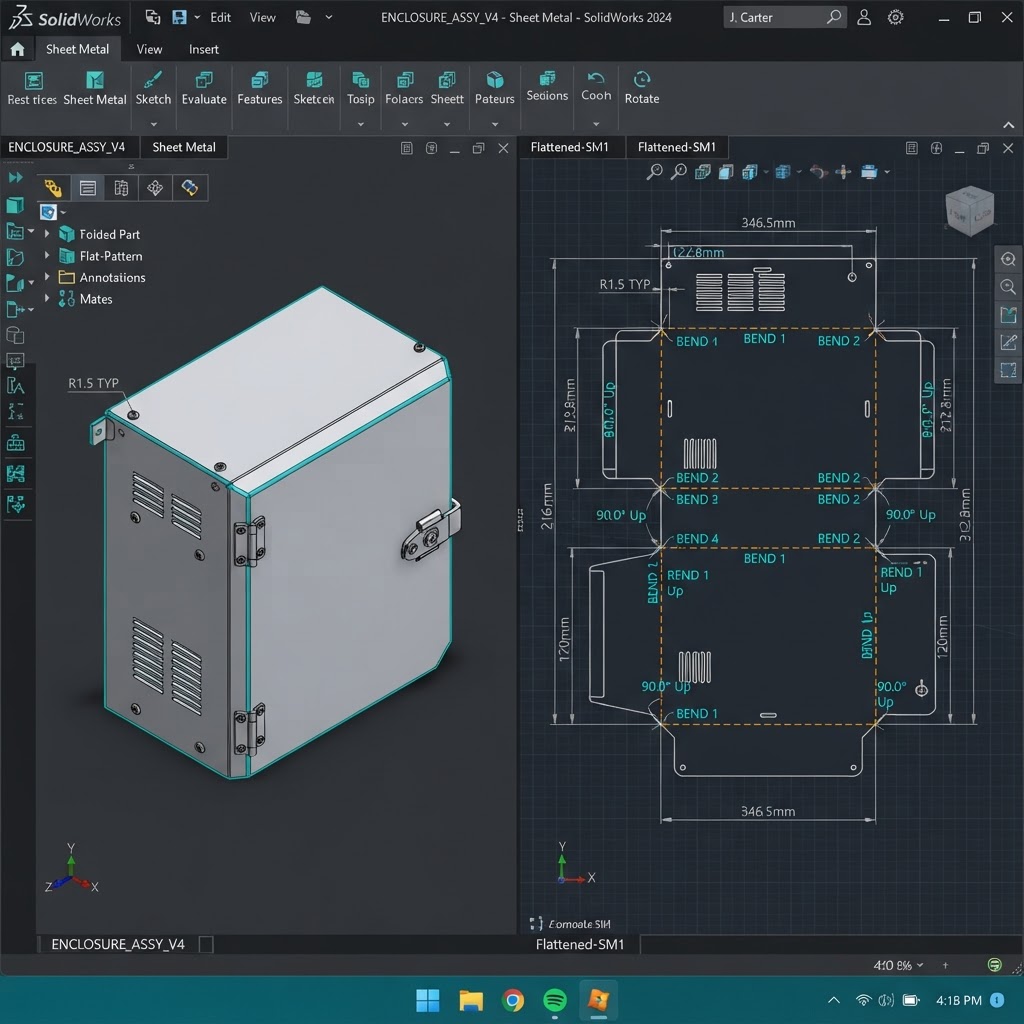
Many fabrication shops receive 3D sheet-metal models from customers or designers. Before those parts can be nested, cut, or estimated, someone usually has to unfold the model into a flat pattern, check the result, and record bend-related details.
Sheet-metal design preparation software takes suitable models through an agreed unfolding workflow. It checks whether the geometry is suitable, applies bend assumptions you approve, and produces flat patterns that staff review before the part moves to nesting or estimating. Models that fail the checks are routed to manual attention instead of producing unreliable output.
Common Challenges
Situations This Capability Can Address
Manual unfolding takes repeated effort
Staff open each suitable model, unfold it in CAD, and export the flat pattern by hand, part after part.
Unsuitable models found late
Models without proper sheet-metal definitions, such as missing thickness or bend data, are only discovered partway through preparation.
Bend assumptions vary between people
Different staff apply different bend allowances or K-factors, so flat patterns from the same model can differ.
Flat patterns need re-checking
Exported patterns are checked manually against the model, which adds a step to every part.
How eSquall Can Address These Challenges
Possible Implementation Approaches
Each approach below is a proposed implementation, scoped and validated for your files and workflow. Nothing on this page describes a completed customer result.
Client situation
Flat patterns are exported one manual unfolding at a time.
How we can help
We build an import-and-prepare workflow for suitable models, covering formats such as STEP/STP and SLDPRT, so flat patterns are produced in a repeatable process instead of one export at a time.
Client situation
Unsuitable models are discovered late in preparation.
How we can help
The workflow checks each model against agreed suitability criteria, such as consistent thickness and usable bend geometry, and routes unsuitable models to an exception list early.
Client situation
Bend allowances differ between staff.
How we can help
Bend assumptions, such as allowances or K-factors, are configured from your standards and applied consistently. They remain subject to your approval.
Client situation
Exported patterns are hard to verify.
How we can help
Each prepared flat pattern is presented alongside the source model for staff review, with notes on what was checked and which assumptions were applied.
Scope and Potential Deliverables
Inputs, Work, Review, and Outputs
What You Provide
- Representative 3D sheet-metal models in the formats you receive, such as STEP/STP or SLDPRT
- Your bend allowances, K-factors, or other unfolding standards
- Suitability criteria for models, agreed with your team
- The output format for flat patterns, such as DXF, and any naming rules
Processing or Implementation Work
- Importing suitable models and checking geometry suitability
- Applying the agreed bend assumptions during unfolding
- Generating flat patterns in the agreed output format
- Flagging unsuitable or ambiguous models as exceptions
Review Responsibilities
- Staff review flat patterns against the source model before use
- Bend assumptions are approved by your team and applied consistently
- New model types are validated with representative samples
Possible Outputs
- Flat patterns for suitable sheet-metal models, subject to validation
- Exception lists for models that cannot be prepared automatically
- Assumption records showing which bend settings were applied
Workflow
How the Work Typically Proceeds
Share Sample Models
You provide representative models in the formats your customers send.
Agree Suitability Rules
We define which geometry qualifies and which bend assumptions apply.
Prepare and Review
The workflow produces flat patterns for suitable models and staff review them.
Validate and Hand Over
Results are validated against expected outcomes before the process becomes routine.
Technical Boundaries
Limits, Assumptions, and Review Requirements
- Not every 3D model can be unfolded. Flat-pattern preparation is limited to suitable sheet-metal models, and suitability is validated with representative samples.
- Bend assumptions must be approved by your team. The software applies your standards; it does not decide them.
- General 3D DWG processing is not an established capability. Suitable 3D import routes such as STEP/STP and SLDPRT are the assessed paths.
- IPT (Autodesk Inventor) compatibility requires representative sample testing.
- Flat patterns are prepared for review and downstream use. Final production responsibility remains with your team.
Project Estimate and Planning
Information Needed to Estimate This Work
Sharing the information below lets us assess the work and prepare an estimate.
Cost and timeline are confirmed after the scope and technical review described above. No price, delivery period, savings figure, or result is implied by this page.
FAQs
Sheet-Metal Design Preparation FAQs
Next Steps
Have Models You Need as Flat Patterns?
Share representative models and your unfolding standards, and we will assess suitability and assumptions together.